
SMP at Steyning Festival
SMP Chair David Hide reflects on the SMP event at the Steyning Festival
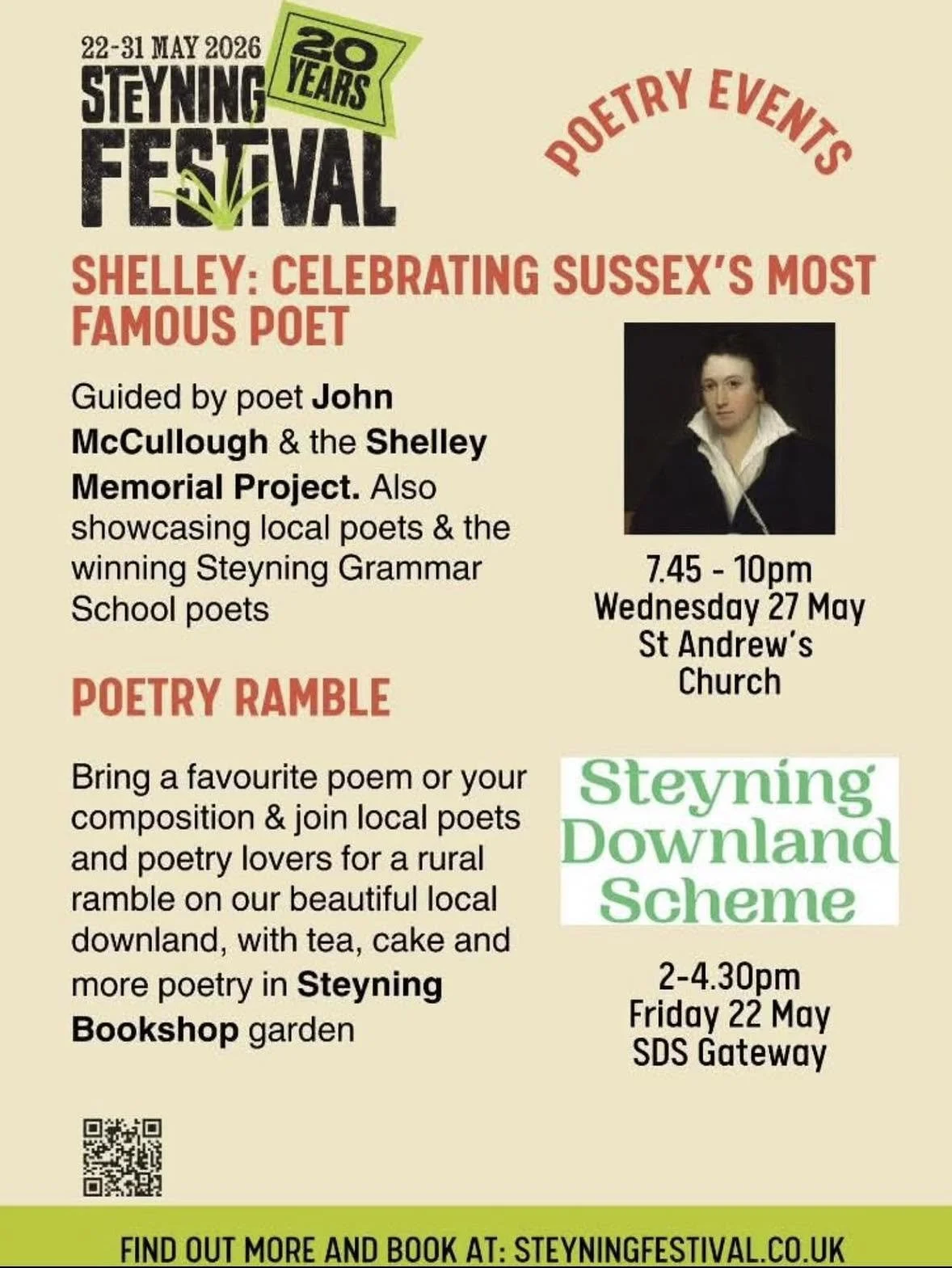
We were thrilled to be asked to take part in this year’s Steyning Festival, where we shared the stage with legendary Brighton Poet John McCullough, Steyning Grammar School students and members of the audience who took part in an open mic.
It was an evening of many parts which were all expertly managed by Steyning poet and SMP member Simon Zec in his capacity as host.
The SMP opened the evening with a presentation all about West Sussex's great poet, Percy Bysshe Shelley.
The presentation celebrated Shelley’s life, work and radical thinking. I was joined on stage by fellow SMP members, Sara and Peter, who, in the reading of two of Shelley’s most famous poems, brought Shelley’s story to life.
Shelley’s poetry is instantly recognisable not just for its lyrical beauty but in many instances for the power of its message. His words continue to echo across the centuries, from the stark commentary of Ozymandias: ‘Look on my works, ye mighty, and despair!’ to the prophetic hope of Ode to the West Wind: ‘If Winter comes, can Spring be far behind?’ The soaring joy of To a Skylark contrasts with the most powerful call for justice in The Masque of Anarchy. The scope of Shelley’s work encapsulates the inspirational beauty of the romantic as well as the political. He was a poet who believed deeply in the power of words not just as decoration, but as a means of inspiring transformative change.
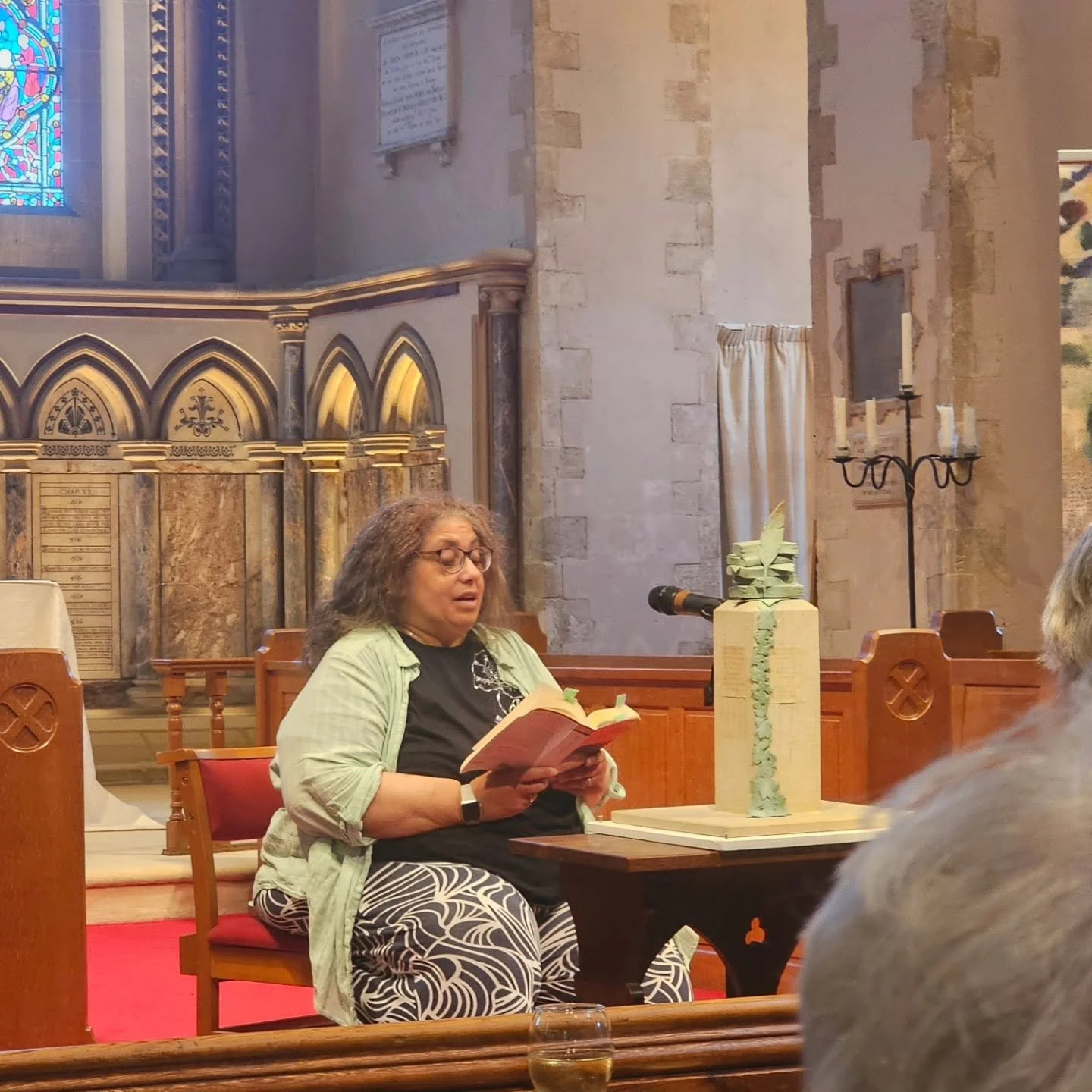
Sara Loewenthal reads Song to the Men of England
Sara’s chosen poem, Song to the Men of England, reveals Shelley at his most politically charged. Written in 1819, it asks workers a simple but perhaps eternal truth: Why do you labour for those who exploit you? ‘The seed ye sow another reaps; The wealth ye find another keeps…’
Shelley stops short of calling for outright revolt in this poem, which Sara so powerfully read; he saved that for The Masque of Anarchy, but the poem became an anthem for the Chartists and later workers’ movements. Its imagery of “cradle to the grave” even anticipates ideas we now associate with the Welfare State.
Sara’s personal story, discovering Shelley through Jamaican dub poet Mikey Smith is a reminder of how radical art travels. On the night Sara explained how her views ‘…. changed when I watched an early 80s Arena documentary called “Upon Westminster Bridge” which was about the Jamaican dub poet, Michael Smith. In it, he and London based dub poetry legend, Linton Kwesi Johnson meet with the great Trinidadian intellectual and radical, CLR James who talks about his love for Keats and Shelley, but he also understood that English poetry meant nothing to younger Caribbeans. It was something I fully understood. Later in the programme, Smith reads this poem at Poets’ Corner in Westminster Abbey. It was so powerful hearing Shelley in a Jamaican accent. My opinion of English romantic poetry completely changed, and I sought out more Shelley although my interest really began when I became part of the SMP.’

Peter’s chosen poem, The Flower that Smiles Today (Mutability II), shows another side of Shelley — the melancholic philosopher of impermanence. ‘The flower that smiles to-day Tomorrow dies…’
Shelley wrote this just a year before his death, and its reflections on fleeting joy, fragile virtue and the inevitability of loss feel hauntingly prophetic. Like Yeats a century later, Shelley understood that beauty is brief and that this fragility is part of what makes life meaningful.
Both Peter and Sara read their poems beautifully, engaging new audiences with Shelley’s work.
The session then went on to consider just how Shelley became a literary icon. Racing through his extraordinary life, we touched on the following key moments:
Born in 1792 into an aristocratic family at Field Place, Warnham
Educated at Eton and Oxford
Expelled from Oxford for refusing to renounce The Necessity of Atheism
Eloped at 19 with Harriet Westbrook
Fell in love with Mary Wollstonecraft (later Mary Shelley)
Travelled across Britain, Ireland, France and Italy
Wrote over 400 poems and hundreds of essays
Died tragically in a boating accident at age 29

David Hide explores the power of Shelley’s work
His heart, famously said to have refused to burn on the funeral pyre, became a symbol of his enduring passion and defiance and was eventually gifted to his second wife Mary.
Shelley’s work sold poorly during his lifetime, much of it remaining unpublished for fear both publisher and poet would be imprisoned, but thanks to Mary Shelley, their son Percy Florence, and Lady Jane Shelley, his legacy grew. By the mid-19th century, he had become the poet of the working class, the Chartists, and countless radicals and his poem Queen Mab, which explains that ‘ another world’ is possible, became a bestseller.
Shelley’s admirers span continents, centuries and ideologies. Included among them are: Mary Shelley, Karl Marx & Lenin, Thomas Hardy, Robert Browning, Oscar Wilde, George Bernard Shaw, Walt Whitman, Mahatma Gandhi, Martin Luther King, The Cure, Paul Weller, Benjamin Zephaniah. His words were shouted in Tiananmen Square in 1989 and during the Egyptian revolution of 2011. Few poets can claim such global, lasting impact.
Finally, we considered why Shelley matters today.
Shelley may have died young, but the power of his writings remain; they continue to inspire in classrooms, protests, political movements, and in the hearts and minds of those who believe in justice, imagination and the transformative power of art. Shelley’s themes of liberty, nature, and love remain universal. His challenge to tyranny and oppression feels very contemporary, and his belief that poets are ‘the unacknowledged legislators of the world’ reminds us that art shapes society as much as politics does.
As Harold Bloom wrote: Shelley is ‘a superb craftsman, a lyric poet without rival, and one of the most advanced sceptical intellects ever to write a poem.’
We concluded by reminding the audience about how the Shelley Memorial Project is working to commission a public artwork celebrating Shelley in West Sussex, but also how the project is much more than a monument. It’s a growing community dedicated to celebrating poetry and literature, hosting talks, events and competitions, Inspiring young writers and keeping Shelley’s radical spirit alive!
To find out more about the project, email shelleymemorialproject@btinternet.com